

How to Scale Your Amazon DSP to 100+ Routes — From Someone Who Actually Did It
If you are reading this, I already know what is running through your head.
Maybe you are at 30 routes and wondering if 100 is even realistic. Maybe you are at 60 and feel like you have hit a wall you cannot explain. Or maybe — and this is the hardest one to admit — you have quietly convinced yourself that the DSPs running 80, 100, 120 routes are just different from you. Better funded. Better connected. Just... better.
I know that feeling because I lived it. And I am here to tell you: you are wrong. Not about the struggle — the struggle is real. But about the ceiling. That part is not real. That is the story we tell ourselves when we do not yet have the right system to prove otherwise.
I helped build a DSP from zero to over 100 routes — top 10 in the country by route volume. We held Fantastic Plus through peak season, the hardest stretch of the year when every DSP in the country is white-knuckling it just to survive. On our single worst day — 120 active routes — we had 6 drivers call out.
That is not luck. That is a system.
Where It All Started — And How Messy It Really Was
Let me be honest about how we started: group texts, spreadsheets, sticky notes, and a whiteboard that someone inevitably erased. Verbal warnings nobody remembered giving or receiving. Schedules that lived inside one person's head and collapsed the moment that person had a bad morning.
And hiring? Do not get me started. We were posting on Indeed and spending entire days sifting through applications that went nowhere. Multiple calls and texts just to get someone to show up for an interview — only to find out they were not even 21. Candidates who made it through every single step, did everything right, then ghosted on the morning of classroom training. Or worse — you would see a name sitting in your pipeline, mean to follow up, life got busy, and two weeks later you would find out they took a job somewhere else because things fell through the cracks and you simply forgot about them.
Sound familiar?
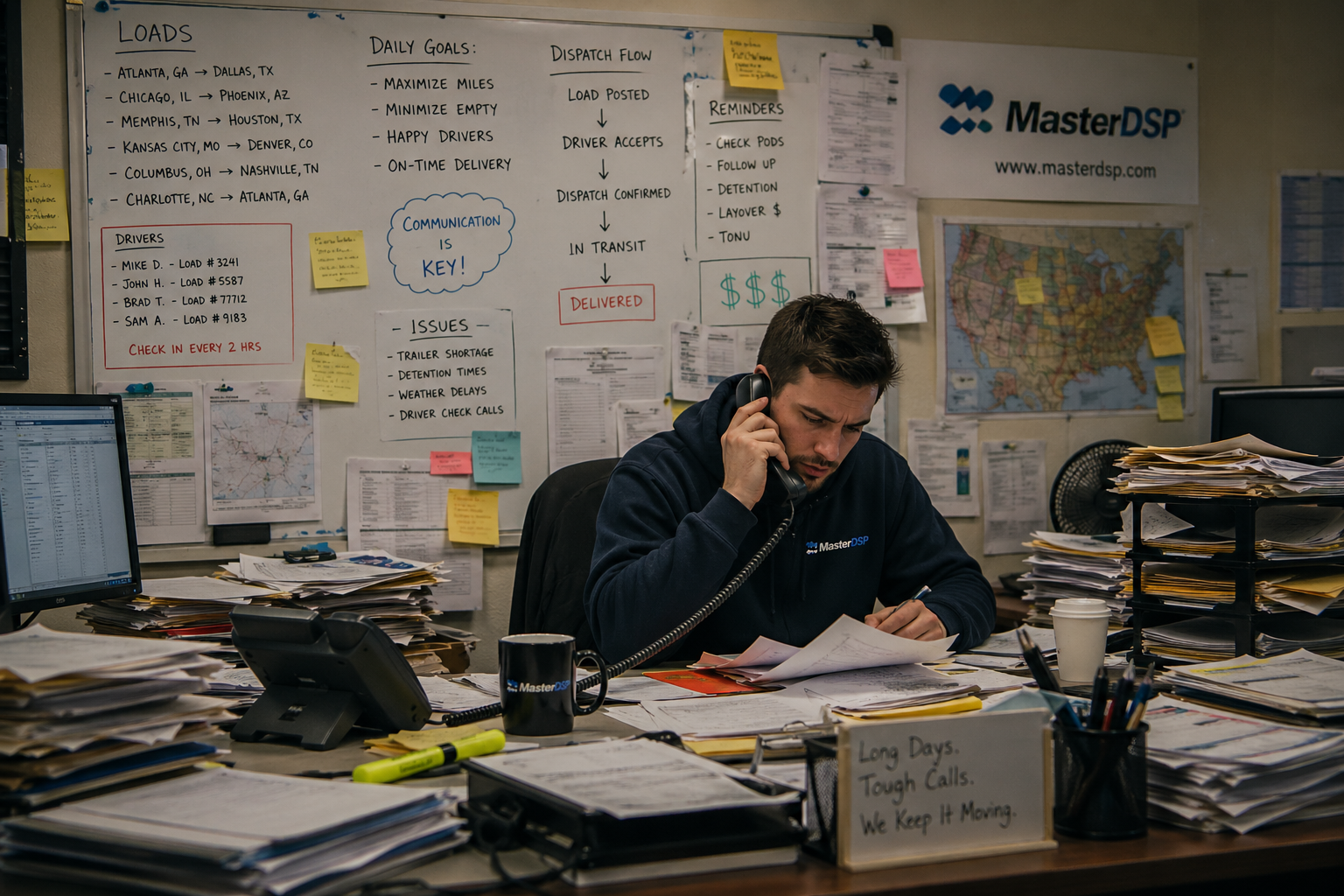
We were running a seven-figure logistics operation like it was a neighborhood carpool. And for a while — when the route count was low and the team was small — we got away with it. But the moment we started scaling, everything that was slightly broken became catastrophically broken.
Callouts skyrocketed because there was no accountability structure. Not because we had bad drivers — but because there was nothing holding the standard in place when nobody was watching. Candidates ghosted because our hiring process was a mess of back and forth texts with no clear next step, no automation, and no way to keep track of who was where in the process. Our scorecard would get flagged by Amazon and we would find out on a Friday — too late to act that week. Dispatchers were spending half their shift chasing information that should have been available at a glance.
We were working harder than ever and still feeling like we were one bad day away from falling apart. That is the paradox nobody warns you about when they tell you to scale. They say: hire more drivers, run more routes, push for Fantastic Plus. What they do not tell you is that without the right operating system underneath all of it, growth just means more chaos at a higher volume. More routes did not solve our problems — it amplified every crack in our foundation.
The Turning Point — Realizing It Was Never About The People
For the longest time, when something went wrong, the instinct was to blame the person. Driver calling out constantly? Bad hire. Scorecard dipped? Lazy team. NCNS for the third time — but we look away because we need bodies, and the cycle continues.
But here is the thing about that cycle — it never ends. You replace one person and the same problem shows up with a different name on the schedule. You have a hard conversation, nothing is documented, and three weeks later you are having the exact same conversation again. You tighten up in one area and something else falls apart somewhere else. It feels endless because without structure, it is endless.
But when you are seeing the same problems repeat themselves across different people, different shifts, different seasons — at some point you have to ask a harder question: what if it is not the people? What if it is the culture and policy they are operating inside?
That question changed everything for us. We stopped asking "how can we hire better?" and started asking "what does our operation need to look like for our people to show up and do the right thing?" The answer was structure. Clarity. Accountability built into the daily rhythm of the operation — not enforced after the fact.
When expectations are unclear, even good people make bad decisions. When accountability is inconsistent, even motivated people start to test the edges. But when the standard is documented, visible, and applied equally to everyone — something shifts. People rise to meet it. The ones who will not self-select out. And the team that remains is the most reliable, most cohesive group you have ever built.
When you build the right system, average people produce above average results. When you build the wrong system, even great people underperform.
What Changes When The System Is Right
Once we made that shift, everything looked different.
Hiring stopped being reactive. We were not scrambling for candidates when we needed bodies — we had a pipeline that ran continuously, filtered candidates against our standards automatically, and documented every decision so nothing ever fell through the cracks again.
Scheduling became something we controlled instead of something that controlled us. We built the week before it started, published it to every driver's phone, tracked confirmations in real time, and had coverage built in before a single callout happened. When drivers did call out — and they always will — we were never scrambling. We were already covered.
Accountability became consistent. Not dependent on who was working that day. Not subject to interpretation. Not lost in a conversation that nobody wrote down. Every standard was clear, every infraction was documented, and every driver knew exactly where they stood — because the system tracked it automatically for everyone equally.
And the scorecard stopped being a surprise. Instead of finding out about problems when Amazon flagged us on a Friday afternoon, we were tracking driver level performance week over week. We knew who needed coaching before it became a scorecard issue. We were leading the conversation instead of reacting to it.
The results spoke for themselves. Top 10 in the country. Fantastic Plus through peak. Six callouts on our worst day running 120 routes. Not because we were lucky. Not because we had better drivers than everyone else. Because we built a system that made the right behavior the easy behavior.
Why I Built MasterDSP
After everything we achieved, I looked at the tools available to DSP owners and felt genuinely frustrated. There was no single platform that did what we had figured out how to do. Scheduling tools. HR tools. Scorecard notification tools. But nothing that brought it all together into one coherent operating system built specifically for the way a DSP actually runs.
So I built it — not as a tech person, not as someone who always wanted to build software, but as someone who had lived inside this operation, felt every pain point personally, and knew exactly what needed to exist.
Most DSP software is built by people who have never dispatched a driver in their life. They have never managed a callout at 4am. They have never watched a scorecard drop because a coaching conversation happened too late. They have never lost a great candidate because the follow up fell through the cracks.
I have. And that changes everything about how MasterDSP was built.
Every feature traces back to a real problem we solved. The hiring pipeline. The scheduling system. The dashboard. The driver profiles. The scorecard coaching. The point based accountability framework. All of it built from the inside out — by someone who has been exactly where you are.
You Can Do This Too
If you are sitting there thinking 100+ routes is someone else's achievement — hear me directly: the DSPs running at that level are not smarter than you. They are not luckier than you. They do not have access to something you do not.
They have a system. And now, so can you.
The difference between a DSP that plateaus at 40 routes and one that scales to 120 is not talent, funding, or connections. It is whether the operation is built on a foundation that can hold the weight of growth. It is whether the people inside that operation have the clarity, accountability, and tools they need to perform consistently — day after day, week after week, through peak season and beyond.
That is what MasterDSP was built to give you.
MasterDSP is the complete operating system built exclusively for Amazon Delivery Service Partners — hiring, onboarding, scheduling, attendance, accountability, and scorecard coaching in one platform.
We are launching 06.02.2026.
Sign up today for exclusive early access and your first 60 days free. No credit card required.
DSP operation has always been about teamwork. And we're on your team.
By Tara R. | Founder, MasterDSP
